

2 Inch Stainless Steel Glass Spacers – How to Protect the Glass?
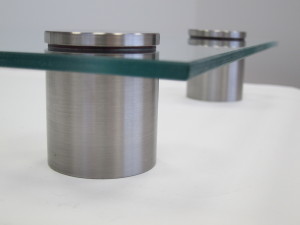
2 inch diameter stainless steel glass spacers, also known as standoffs, are very common today as architects increasing incorporate glass into their designs. One frequent question we receive is how to protect the glass from the stainless steel. We carry a few different products at Monarch to help with this.
First is a plastic washer that sits between the glass and the standoff. At Monarch we carry these in a clear vinyl and in a black neoprene, both of which are 1/8” thick in the case of the 2” diameter spacers.

Second is taking care in protecting the hole. As a general practice, we find that the hole should have a diameter equal to or at least 1/16” thicker than the glass itself. You also want to be careful not to drill your holes too close to the side of the glass. Finally, many stainless steel glass spacers have a collar on the cap to avoid having to use a heavy duty threaded rod to connect them. Monarch offers clear PVC tubing cut to size to protect the glass from vibrating against the edge of the standoff.
As always, if you have any questions on your specific application, we are here from 8am to 5pm ET and would be glad to help. Our number is 631-563-8967.
Sharp Corner Stainless Channel – Brushed Finish
I thought I would share some pictures from a recent sharp corner stainless channel job we did here at Monarch Metal. Â The piece had a 8 inch base with a 2 1/2 inch leg and was 20 feet long. Â We finished the outside faces and base of the piece.


The difference in this product vs. a typical hot rolled channel is both the square top of the legs (vs. tapered) and the sharp inside angle that is achieved.
Cutting Stainless Steel on the Job Site
Having the right tools and using the correct process to cut stainless steel on the job site can make the difference between a rough cut that takes forever and a normal clean cut.
This may sound obvious, but you should first see if you are able to have the pieces cut to the right size by your fabricator. Â Your fabricator likely has the appropriate equipment and experience to do this for a fraction of cost vs. the labor it would cost to be cut to size at the job site. Â We know this is not always possible as some measurements are always going to need to be taken on the job site.
This article is geared towards cutting stainless steel for architectural applications on the job-site, so we will skip a discussion of shearing, laser cutting, water-jetting, cold sawing and flame cutting and focus on cutting sheet, structurals and bar less than 1/8 inch thick. Â The tools for these applications include chop saws, abrasive saws, hack saws and band saws.
…
Polished Stainless Sharp Corner Structurals
In follow up to our post from last week, we wanted to give customers an idea of what a mirror polished or brushed finished stainless steel sharp corner structural would look like. Â We took those same rectangular stainless tube cuts and the stainless t bar and applied a #8 mirror polish to once face and a #4 brushed finish to the adjacent face. Â The brushed finish was a little more difficult because the pieces are so short and we couldn’t use our automated equipment.

You can see from the the picture above that the advantage of the sharp corner stainless shapes is that there are flat edges to polish. Â The result is a far better polished finish than what might be available on the typical commercially available stainless hot rolled structurals. Â This has applications for stainless angle, stainless t bar, stainless square and rectangular tube and stainless steel channel.
Sharp Corner Stainless Angle, Channel & T Bar
Sharp Corner Stainless Structural Angle & Channel Now Available
Monarch has recently added a new product that we are excited to share with our customers. Monarch is now providing sharp corner stainless shapes. Generally, the only options for customers when using stainless steel in architectural applications was using hot rolled or cold rolled stainless structural shapes such as angle, channel and t bar.
 |
 |
With these structural profiles, there is a radius on the interior corners that can limit their applications when one desires for them to sit flush against panels or corners. The new sharp corner stainless angle has a fillet on the interior angles that is often less than 1/32”. The mill finish on our new line will be bead blasted, but as per usual we can offer it in a brushed finish or a mirror polished finish. Minimum orders will apply.
 |
 |
Comparing How Quickly Steel, Galvanized Steel, Aluminum and Stainless Steel Rust
Even though we typically recommend stainless steel for outdoor applications, we are often asked how well other materials hold up. Â It is hard to answer this question because it depends on the environmental factors of the application (climate, humidity, temperature, direct exposure to elements vs. shielded, etc.) Â At a minimum though, we thought it would be helpful to run a very simple experiment to show people what typical oxidation looks like at various times.
To begin, we collected the following items necessary for the experiment:
(1) Large Cup of Black Coffee
(2) Gallons of Distilled Water
(1) Salt without Iodine additive
(12) Jars
(4) Stainless Steel Clips
(4) Steel Clips
(4) Galvanized Steel Clips
(4) Aluminum Clips
We used the salt and the distilled water to create a standardized 5% solution of NaCl, know as NSS or neutral salt spray. Â From there the experiment is quite simple. Â We will hold the control to the side and then at various times in the future we will remove the samples from the jars and compare with the control pieces to compare the oxidation.
…
Comparing How Quickly Steel, Galvanized Steel, Aluminum and Stainless Steel RustRead More »
Low Profile Stainless Steel Standoff Cap Available in Diameters Up to 2 Inches
Monarch Metal is pleased to announce a new low-profile stainless steel standoff cap product line. The slim, low-profile cap has a radius to show a smooth aesthetic without a standoff cap sticking up when you are installing a countertop, a transaction counter, or a glass surface.


The new low-profile caps, in addition to the barrels, are made from a corrosion-resistant 303 alloy stainless steel. This stainless steel alloy provides excellent corrosion resistance in hostile environments. The standard finish for these is a brushed finish, but they are also available in a mirror-polished finish.Low Profile Standoff Cap Sizes
The stainless low-profile caps are available in a variety of diameters, including 1”, 1.25”, 1.5”, and 2” diameters.
Monarch Metal also provides the complementary hardware including clear vinyl washers, tubing/gaskets, threaded connector rods, and hanger bolts for mounting.
2 Inch Diameter Stainless Standoffs – 2” Dia SS Countertop Supports
We do quite a bit of custom work in 2 inch diameter stainless steel standoffs. Â What can really make the difference among suppliers to consider is (i) the type of stainless steel round stock they are manufacturing from, (ii) the manufacturing flexibility to accommodate your design needs, (iii) the finish and (iv) the lead time.

Input Material for 2 Inch Stainless Standoffs
At Monarch, we use solid 303 Alloy Stainless Rounds as the base material for our standoffs. Â This provides powerful corrosion resistance. Â From time to time customers will request that we use a 316 marine grade stainless steel if the application will be in a particularly corrosive environment.
Standoff Finishes
The stock finish, and by far the most common finish we offer for stainless standoffs, is a brushed finish. Â A brushed finish is a beautiful grained finish in the material with a little shine to it. Â Another popular finish is a mirror polished finish. Â Because the base material is stainless steel, you don’t have to worry about coating or painting the material.
To find out more about our 2 inch stainless steel standoffs, contact us at 631-563-8967 or submit a quote request online here:Â https://www.monarchmetal.com/how-to-buy/get-a-quote/
Stainless Steel Standoff Finishes
Stainless steel makes a great base material for standoffs because of its strength, corrosion resistance, ease of maintenance and natural aesthetic appearance. Â The aesthetic appearance that customers see is not the way the materials shows up at the shop though!
Generally, when working with stainless steel, manufacturers will offer mechanically applied finishes, rather than coatings, because the coating would likely be less durable than the material itself, and you are already paying a premium for the material. Â The two most popular mechanical finishes are a brushed finish and a mirror polished finish. Â A brushed finish is quite simple and is accomplished by applying an abrasive to the outer diameter and then blending the finish with a lighter abrasive such as a skotch brite. Â Sometimes if the stainless round is pitted, the manufacturer will take a .010” skin cut to the diameter to remove any surface imperfection and have a better starting point to save time finishing. Â Brushed finishes are generally accomplished on a lathe but another alternative would be to center-less grind the material.
To enhance the finish to a mirror polish, you effectively need to make the surface even smoother through the use of increasingly higher abrasives and then polishes. Â A mirror polish requires quite a bit more time than a brushed finish because rather than having the finish applied at 1 or 2 passes, a mirror polish can oftentimes require 7-8 handlings.
The picture below shows stainless steel standoffs with brushed and mirror polished finishes.
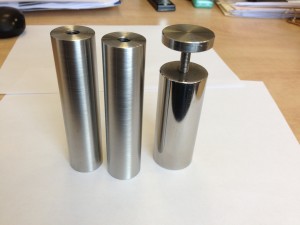
One thing to be careful of when specifying stainless standoffs is matching hand finishes with mechanical finishes. Â Stainless steel trim in architectural applications is often made from mechanically polished stainless steel sheet, which is entirely different equipment than what is used in finishing stainless steel standoffs. Â The specifier should be conscious that these finishes will not identically match.
Architectural Bronze Statuary Bronze Kick Plates
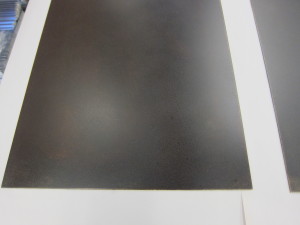
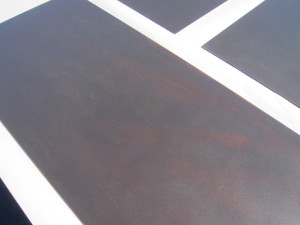
Monarch recently fabricated some bronze / brass kick plates with a custom architectural bronze / statuary bronze finish. We always really enjoy jobs like these because they are such a pretty trade finish, and the craft for applying this finish correctly is just dying. You can see the deep coloring the oxidized bronze takes on and in the close up you can see the natural color variation in the material.
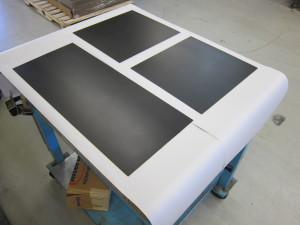
Monarch custom fabricates these to order, so they are available in a variety of sizes in large and small quantities.


