

Custom Aluminum Extrusion Sourcing: Domestic vs. Foreign Suppliers (2025 Guide for U.S. Buyers)
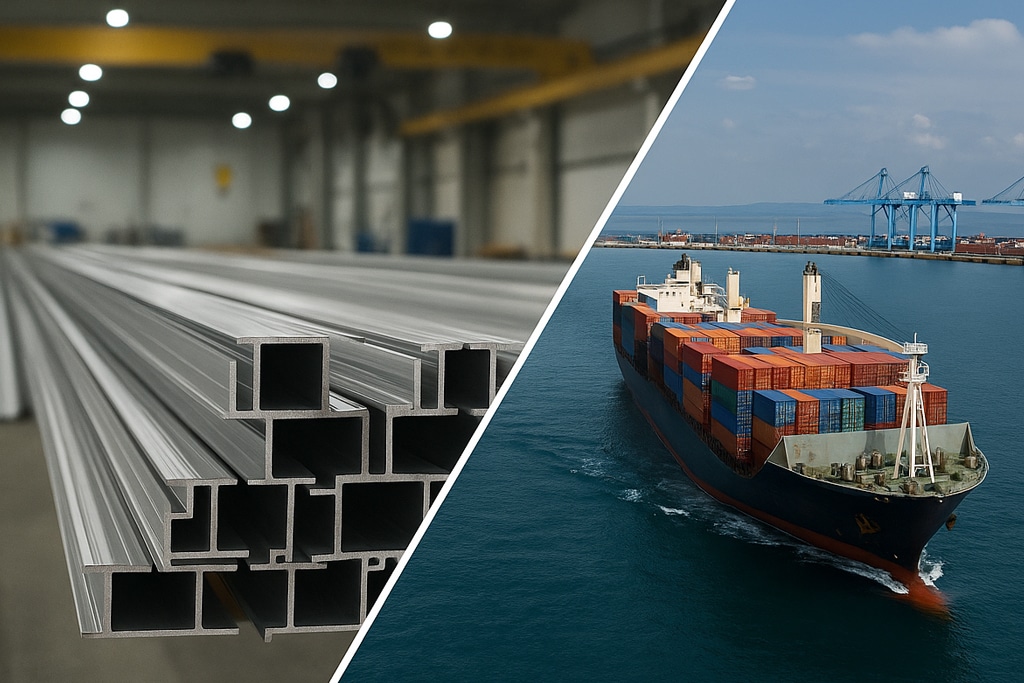
An in-depth look at how cost, compliance, and sustainability factors influence whether your next extrusion project should stay domestic or go offshore.
Sourcing custom aluminum extrusions used to be a simple price equation. Whoever could hit your spec and quote the lowest per-pound rate usually won the business.
In 2025, that is no longer the case. The sourcing decision now hinges on lead time, compliance risk, quality control, and total landed cost, not just the line item on a quote sheet.
With the Build America, Buy America (BABA) rules now fully enforced, rising Section 232 tariffs, and UFLPA forced-labor scrutiny on aluminum imports, U.S. buyers are rethinking how and where their extrusion programs should run.
This guide breaks down the real trade-offs between domestic and foreign extrusion suppliers so you can make decisions grounded in facts, not assumptions.
When Domestic Extruders Win
Domestic sourcing is more than a patriotic decision. It is a strategic one. U.S. extruders tend to win when projects demand:
- Short lead times and the flexibility to handle frequent design changes.
- Direct engineering support for DFM/DFX collaboration and on-site visits.
- Guaranteed BABA compliance and traceable documentation for federally funded work.
- Simplified communication across time zones and departments.
- Lower risk exposure to tariffs, shipping delays, and customs holds.
For projects tied to public infrastructure, aerospace, or OEM assemblies that require strict documentation, domestic sourcing is not just faster, it is safer.
When Offshore Supply Makes Sense
Foreign extrusion mills still have a strong case under the right conditions. If your demand is steady, high-volume, and price-sensitive, importing can deliver meaningful savings provided you have the working capital to manage longer pipelines.
You will typically see lower unit prices at scale, especially from well-established operations in Asia, Europe, and the Middle East.
But those savings must be weighed against:
- Ocean freight and drayage costs.
- Section 232 tariffs (some now as high as 100 percent).
- Managing the correct tariff amount on the correct cost basis.
- Inventory carrying costs during extended transit cycles.
- UFLPA traceability requirements, which are now fully enforced on aluminum supply chains.
For buyers with predictable schedules and no BABA obligations, offshore sourcing can still fit. Just make sure your landed cost model includes every variable.
Understanding Total Landed Cost
The smartest sourcing teams now calculate total landed cost (TLC) instead of focusing on per-pound pricing.
TLC = Ex-works price + Freight + Duties + Tariffs + Compliance + Carrying Cost + Risk Buffer
Even a small shift in freight time or tariff rate can change the math. For example, an eight-week ocean cycle that forces you to carry two extra months of inventory at an 18 percent annual cost can erase a 5 to 8 percent price advantage overnight. Add to this the constant threat of changing tariff amounts that are due at time of receipt in the USA.
Bottom line: cheap quotes are not always cheaper once you account for transit, tariffs, and risk.
Lead Time and Agility
Domestic extruders routinely turn around dies and production runs in three to eight weeks once billet is booked. Once the dies are made and in use, lead times are drastically reduced for repeat orders, in many instances, as low as two weeks from order to delivery. By contrast, ocean freight from China to the U.S. West Coast averages about 32 days door-to-port, or 52 days to the East Coast, not counting customs and drayage.
That lag can make a difference when you are trying to manage product launches, PPAP cycles, or last-minute design changes. If agility matters, closer is better. This is especially true if you need LTC quantities, domestic sourcing gives the most flexibility compared to foreign lot sizes.
Quality, Standards, and Engineering
Most projects fall under ASTM B221, covering extruded bars, rods, profiles, and tubes. The go-to alloys are 6063-T5 for architectural work and 6061-T6 when higher strength and customization is required.
Domestic extruders tend to excel at tight DFM feedback loops, fine-tuning die design, tongue ratios, and hollow features that can save downstream machining costs. Overseas suppliers can match performance on large, repeatable orders but typically lack the fast iteration pace that small U.S. runs can offer.
Compliance Realities for 2025
Build America, Buy America (BABA)
The FHWA’s 2025 rule change officially ended the decades-long “manufactured products” waiver. That means many federally funded highway and infrastructure projects now require aluminum products to be U.S. made unless a specific waiver applies.
Section 232 Tariffs
Tariff policy remains a moving target, but as of mid-2025, certain aluminum imports face up to 50 to 100 percent tariffs, substantially shifting landed-cost models.
UFLPA (Forced-Labor Law)
Aluminum is now designated a high-priority sector for enforcement. Importers must be able to trace the entire chain (bauxite → alumina → smelter → billet → extrusion) or risk detention at U.S. Customs.
EU CBAM (Carbon Border Adjustment Mechanism)
If you export aluminum products to Europe, expect carbon certificates and fees starting in 2026. Choosing high-recycled or low-carbon billet now can reduce future exposure.
Sustainability and Recycled Billet
Recycling aluminum saves about 95 percent of the energy required to produce primary metal. Most U.S. extruders already use high-recycled billet, which helps meet ESG targets and can pre-position your products for EU CBAM compliance. Foreign mills vary widely, so confirm recycled content and documentation early in the RFQ process.
Managing Risk
Each sourcing path carries its own risk profile:
- Execution risk: More hand-offs offshore mean more potential delays.
- Policy risk: Tariff and trade policy shifts can change pricing overnight.
- Compliance risk: UFLPA detentions are costly; documentation is mandatory.
- IP risk: Proprietary dies and hollows are safer when built and stored domestically.
Understanding which of these matters most to your business is key to choosing the right mix.
Hybrid Sourcing Strategies
Many OEMs and fabricators now run a dual-source model:
- Domestic supplier: Handles prototypes, short runs, and BABA-covered work.
- Foreign supplier: Manages steady-state production for cost efficiency.
You can also cut the master die domestically (for IP protection) and send a licensed replica overseas once qualified. Pair that with two to four weeks of safety stock domestically, and you gain both cost control and resilience.
RFQ Checklist for Custom Extrusions
A strong RFQ should include:
- STEP files and full prints (tolerances, finish, straightness, twist).
- Alloy and finish details (for example 6063-T5, Class I anodize 0.7 mil).
- Tooling policy (ownership, storage, duplication rules, rebate for volume).
- Certifications (ASTM B221, CoC, mechanical and chemistry tests, mill certs).
- Compliance documents (BABA, UFLPA, Section 232 assumptions).
- Logistics plan (Incoterms, port, drayage, OTIF targets).
The more you standardize upfront, the easier it is to compare quotes apples to apples.
Conclusion
In 2025, the calculus has shifted. The days of simply chasing the lowest quote are over. With BABA enforcement, 50 to 100 percent tariffs, ongoing China AD/CVD orders, and tighter UFLPA screening, the hidden costs of offshore supply are easier to underestimate than ever.
Domestic extruders deliver shorter cycles, clearer documentation, and stronger compliance alignment for most U.S. projects, while offshore partners still have a role in steady, cost-driven programs. The best strategy is the one that balances both: speed, quality, and compliance onshore; scalability and efficiency offshore.
At Monarch Metal, we continue to help architects, fabricators, and OEMs navigate that balance, backed by decades of experience in architectural aluminum systems and custom aluminum extrusion manufacturing.


